
Marlene Engelhorn: Best Lesbian+ Activist
Marlene Engelhorn inherited millions—and then asked a group of strangers to decide what should happen to the money. The experiment was about far more than philanthropy. It was about who society trusts with power.
During the third weekend of an unusual democratic experiment in Austria, a participant approached Marlene Engelhorn with an observation that, in most philanthropic settings, might have sounded almost insolent. “It doesn’t matter what Marlene wants,” the participant told her. “This is our project now.” Engelhorn remembers the moment vividly. It was precisely what she had hoped would happen. For months, a group of ordinary citizens had been deliberating over how to distribute approximately €25 million of Engelhorn’s inherited fortune. They were not there merely to offer suggestions or approve a plan she had already devised. They had been given the authority to make the decisions themselves.
The money was substantial enough to attract international attention. But for Engelhorn, the transfer of authority mattered more than the transfer of wealth. While Engelhorn is best known for challenging inherited wealth, her story also reflects a broader question that resonates across many communities: who gets to hold power, who gets to make decisions, and what happens when leadership is shared rather than concentrated.
“It takes time to let go of the influence of existing power structures,” she told me. “But given a thoughtful setting, people will emancipate themselves and reclaim the power that should have always been theirs to begin with.” Most stories about Engelhorn begin with a number: the millions she inherited, the millions she relinquished, the millions she could have kept. It is an understandable emphasis. Enormous fortunes exert a gravitational pull on the public imagination, particularly when someone appears willing to give one away. But Engelhorn’s real subject is power.
Who possesses it? Who is believed capable of exercising it? And why are societies so willing to treat wealth as evidence of wisdom? Her answer to that last question is blunt: classism. “I have no significant expertise whatsoever,” she said. “No degree other than my high school one—but the same people will attribute exquisite decision-making skills to me just because I am so rich.”

Marlene Engelhorn has become one of Europe’s most influential voices for economic justice, challenging wealth inequality and calling for a fairer society.
What the Headlines Missed
There is something unsettling in the frankness of this admission. Wealthy philanthropists typically justify their influence by emphasizing vision, leadership or business acumen. Engelhorn does something different. She questions why her inheritance should have granted her influence in the first place.
The Citizens’ Council she established was therefore not simply a charitable initiative. It was an attempt to challenge a deeply embedded social assumption: that the person who possesses the money should also possess the final word.
Engelhorn, an Austrian activist whose family fortune is connected to one of Germany’s most prominent industrial dynasties, has become a leading European advocate for wealth taxation and democratic reform. In 2024, she entrusted roughly €25 million to a citizens’ council charged with distributing the money among organizations working for the public good. Its members were selected to reflect a cross-section of Austrian society and were given time, information and professional support as they considered what to do. The experiment offered a rare public test of a simple but consequential proposition: What might happen if ordinary people were given genuine authority over a significant pool of private wealth?
The answer, at least from Engelhorn’s perspective, was that they took the responsibility seriously. They researched, debated, negotiated and reached decisions. Yet much of the coverage focused less on the democratic process than on the spectacle of an heiress surrendering millions.
“I was surprised to see how little the media cared for the democratic part,” Engelhorn said. “They were interested first and foremost in the money.” She was equally troubled by suggestions that ordinary citizens could not be trusted to make sound decisions. In her view, this skepticism revealed more about the commentators than it did about the council.
Media organizations in Austria and Germany, she observed, are often staffed by people who possess some degree of wealth or class privilege. Many seemed quick to assume that citizens selected from the broader population would be incapable of handling the responsibility.

The contrast was striking. Commentators questioned the judgment of ordinary people while treating Engelhorn’s judgment as inherently consequential—even though the quality that had distinguished her was not specialized knowledge but inherited wealth.
“It just shows how deeply classism runs in our perception of who should have power and make decisions,” she said.
This is the paradox at the center of Engelhorn’s public life. The fortune she rejects gives her a platform from which to criticize the system that produced it. Her name opens doors. Her wealth attracts journalists. Her decision to relinquish money becomes news partly because so few people in her position do the same.
She is aware of the contradiction. Rather than attempting to escape it rhetorically, she returns to it repeatedly, treating discomfort as something to be examined instead of explained away.
The Discipline of Letting Go
Giving away money is not the same as surrendering power.
Traditional philanthropy often allows donors to retain considerable influence over the organizations they fund. They may determine priorities, impose reporting requirements, demand measurable outcomes and withdraw support when a project no longer reflects their preferences.
Even generosity can preserve a hierarchy: the donor remains the evaluator, and the recipient remains accountable to the donor.
Engelhorn wanted to interrupt that relationship.
She did not select the organizations that would receive the €25 million. Nor did she expect the council—or the organizations it supported—to report back to her personally.
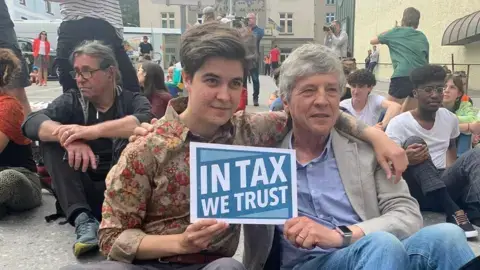
Marlene Engelhorn joins fellow activists in peaceful protest, demonstrating her belief that meaningful change begins when communities raise their voices together.
“As far as I know, the organizations were chosen based on trust and research,” she said. “They know how to do what they do. They need no babysitting or obsessive controlling.”
Her choice of words is deliberate. “Babysitting” and “obsessive controlling” describe a version of philanthropy in which the wealthy person’s confidence in their own judgment survives the gift itself. Money moves, but authority does not.
Engelhorn argues that genuine redistribution requires more than a change in ownership. It demands trust—and a willingness to accept that other people may make choices the donor would not have made.
That is why the council member’s declaration mattered so much. “This is our project now” marked the moment when participants stopped thinking of themselves as temporary custodians of Engelhorn’s wishes. They had begun to understand that the responsibility truly belonged to them.
Democracy, in this sense, was not simply a procedure. It was a psychological shift.
People accustomed to being consulted had become decision-makers.
Democracy Between Elections
In many representative democracies, citizenship is practiced most visibly at the ballot box. People vote, governments form and professional officials conduct the daily business of the state.
Engelhorn does not dismiss that system. Governments, she said, must continue to manage public affairs. But elections alone offer a narrow conception of democratic life.
“We are all affected by policies,” she said, “so we should all be invited to shape them.”
Citizens’ assemblies and councils are built on the idea that ordinary people can do more than register preferences. Given adequate time, reliable information and a structure for deliberation, they can consider evidence, listen to competing experiences and make difficult collective decisions.
That process differs sharply from much of contemporary political culture, which rewards speed, outrage and certainty. Deliberative democracy asks people to remain in the room with complexity. It does not assume that everyone will agree. It asks whether they can reach legitimate decisions together despite disagreement.
Engelhorn’s council dealt with private money, but its implications extended beyond philanthropy. It tested what can happen when citizens are trusted not merely to react to power but to exercise it.
The experiment also raised a difficult question for conventional institutions: If a group of ordinary people can thoughtfully allocate €25 million, what other decisions might citizens be capable of making? to
Learn more about Marlene Engelhorn. Learn more about her new play, “GELD IST KLASSE” (translated as “Money is Great/Class”).
Engelhorn’s criticism does not stop with individual donors. It extends to the existence of large-scale philanthropy itself.
“This experience has deepened my belief that all philanthropy must eventually work on how to abolish itself,” she said. “We do not need it.”
The statement sounds paradoxical, particularly in societies where nonprofit organizations depend on donations to provide food, housing, health care, education and legal assistance. Those services are often urgently needed, and withdrawing philanthropic support without replacing it would harm the people already living with the fewest resources.
But Engelhorn’s argument is structural. Philanthropy can relieve suffering while leaving intact the conditions that produced both the suffering and the donor’s fortune. In some cases, it allows wealthy individuals to exercise influence over public priorities without the democratic accountability expected of governments.
“Philanthropic work needs suffering and scarcity in order to jump in and ‘save’ people,” she said. “I’m disgusted by this.”
Her alternative is not a world in which people cease caring for one another. It is a society in which care does not depend on the preferences of wealthy benefactors—a society that distributes resources more equitably through taxation, public institutions and democratic decision-making.
“We have to create equality and equity,” she said. “As far as I know, only democracy can do that on a large scale.”
There is an important tension here. Communities cannot wait for perfect systems before meeting immediate needs. Grassroots organizations, mutual-aid networks and nonprofits routinely fill gaps that governments have neglected or created. Philanthropy may keep people alive while political movements fight to change the conditions endangering them.
Engelhorn does not deny the value of that work. Instead, she questions why essential services should remain dependent on private benevolence—and why those who accumulated the most money should gain disproportionate authority over society’s response to injustice.
The critique is not that generosity is meaningless. It is that generosity is not justice.
An Heiress Walks Onto a Stage
Engelhorn has also taken her argument into the theater, where the contradictions of wealth and power can be made visible in ways that policy language rarely permits.
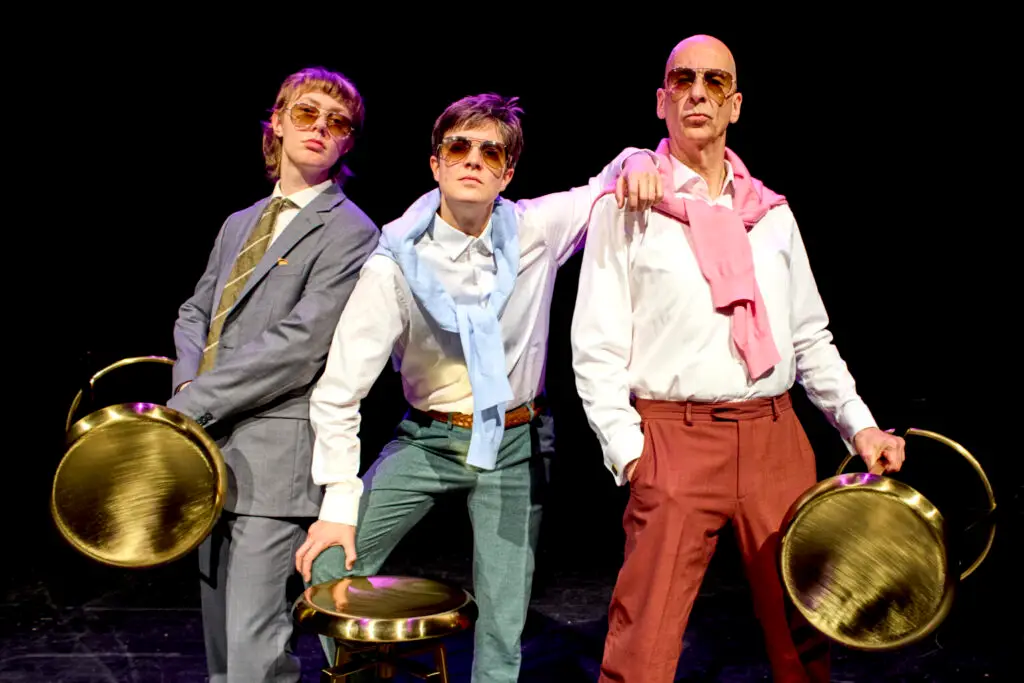
She appears as herself in Geld ist Klasse, a production directed by the German theater director Volker Lösch. The title contains a play on meanings: Money is “class,” in both the social and approving senses of the word.
Lösch had previously developed productions with people whose experiences are frequently discussed but less often heard directly, including sex workers, climate refugees and people living in poverty. When he approached Engelhorn, she said, he wanted to expose both the absurdity and the danger of powerful people.
“He wanted to show how ridiculous powerful people are,” she said, “and how dangerous, though.”
Following extensive interviews, playwright Lothar Kittstein developed the script with the creative team. Onstage, Engelhorn’s position becomes part of the drama. She is simultaneously a critic of concentrated wealth and a person whose inherited fortune ensures that audiences will listen to that criticism.
Theater does not resolve this contradiction. It places it under brighter light.
For Engelhorn, that is part of its power. A book or newspaper article may present an argument, but live performance engages an audience collectively and physically. People sit beside one another as the critique unfolds.
“It engages more viscerally,” she said. “It encourages people to take action if they haven’t yet—or not to give up if they’re already in the fight.”
The production has repeatedly sold out. Its popularity suggests that audiences are interested not only in the spectacle of extreme wealth, but also in the questions concealed beneath it: Why do a small number of people possess so much? Why are their decisions treated as more valuable? And what would it require to distribute power as well as money?
Who Teaches Whom?
Public profiles of wealthy reformers often depend upon a familiar narrative: A privileged person recognizes injustice and then shows others how to address it.
Engelhorn resists that role.
When I asked what she had learned from organizations working in housing, education, climate justice and democracy, she directed attention away from herself.
Smaller grassroots groups, she said, “teach me the most.”
“That’s where I sharpen my thoughts on justice and freedom.”
The distinction matters. Grassroots organizations typically work close to the consequences of policy failure. They see who is excluded from housing, whose labor is undervalued, whose safety is treated as negotiable and whose stories disappear from public discussion. Their knowledge is not incidental to democratic decision-making. It is essential to it.
Engelhorn’s response also reflects the central discipline of her experiment: refusing to confuse visibility with expertise.
A person may have the microphone without having the deepest knowledge. A person may possess resources without understanding what a community needs. And people rarely invited into positions of authority may possess precisely the experience required to make better decisions.
“Take Heart”
Your Lesbian World reaches many women who spend their time performing the patient, often invisible labor from which community is made: organizing gatherings, checking on neighbors, maintaining support networks, creating places where people can arrive alone and leave knowing someone’s name.
This work seldom attracts headlines. It happens one relationship, one conversation and one gathering at a time.
I asked Engelhorn what advice she would offer those community builders.
She declined the authority embedded in the question.
“I don’t think I can give meaningful advice to those who are already organizing and community building,” she said. “I learnt from them.”
To people who have not yet found their place in collective action, however, she offered three brief instructions:
“Join groups, get active, take heart!”
Then she returned once more to the limits of her own perspective.
“My perception of the world has been shaped by my wealth and privileges,” she said. “I don’t think I can say anything other than: thank you, from the bottom of my heart, thank you for your work.”
The defining act of Engelhorn’s experiment was not simply that she parted with €25 million. It was that she refused to dictate what happened next. She placed her confidence in people who are rarely presumed to possess authority and created the conditions in which they could recognize that authority as their own.
The lesson is both hopeful and demanding. Democracy cannot be reduced to faith in ordinary people as an abstract idea. People must be given time, information, responsibility and actual power. Trust becomes meaningful only when it carries consequences.
“Please stay hopeful,” Engelhorn said. “I truly believe that our lives, as well as those of generations yet to come, are worth fighting for every single day, no matter how small of a day it may seem.”
That may be the quiet proposition beneath the millions: A better society will not be bestowed upon us by the people who possess the greatest fortunes. It will be built by people learning to trust one another with the difficult work of deciding what comes next.

About LesbianEarth
LesbianEarth LLC is a privately held media and community company connecting lesbian+ and queer women through trusted journalism, local events, travel, and digital experiences.
Founded in Albuquerque, New Mexico. Building community worldwide.
© 2026 LesbianEarth. All rights reserved.
Want to support queer women doing the work?
 Subscribe to Your Lesbian World
 Visit LesbianEarth.com
 Support Lesbian+ and Queer Women businesses
 Support Lesbian and Queer Women Events Say yes to something rooted, real, and built by us
We don’t need permission to exist.
We just need each other.
With love and fire,
Your Lesbian World / LesbianEarth