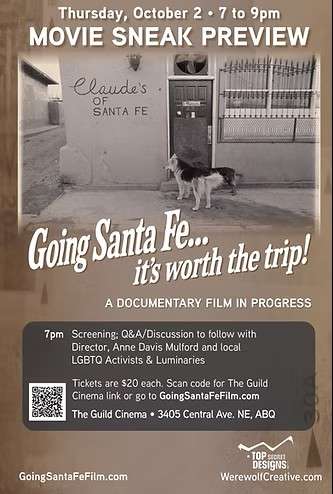
Going Santa Fe: Claude’s Bar and the Queer Haven of the Southwest in the 50s and 60s
In Santa Fe’s desert light, a hidden history emerges—one shaped by exile, survival, and resilience. Filmmaker Anne Davis Mulford’s documentary-in-progress, ‘Going Santa Fe’ traces her search for her mother’s past and, through it, the untold queer history of both Santa Fe, and New Mexico itself. The film explores how, long before social media, an easy access highway of information and connection was created. Santa Fe was well known amongst lesbians and gay men from coast to coast as a sanctuary for those who could not live openly elsewhere.
Claude’s of Santa Fe: A Queer Refuge in the 1950s and 60s
When I sat down with Mulford for this article, she said her mother, Esther, fell in love with Claude James, owner of the legendary Canyon Road bar “Claude’s of Santa Fe”. Her mother took her four children with her but left behind a privileged yet oppressive East Coast life.
In the 1950s and 60s, Claude’s was more than a bar—it was a refuge for any and all who felt ‘other.’ Within its adobe walls, women could dance together and men could hold hands, even as the world outside remained hostile.
Haunted by History: Queer Lives Under the Lavender Scare
That hostility had deep roots. In the 1950s, the Lavender Scare branded queer people as “perverts” and “threats” to national security. The fallout was devastating: arrests, firings, names printed in newspapers, families destroyed. Even those who fled to New Mexico carried the scars. “It caused and supported internalized homophobia in every person who thought they might be gay or lesbian,” Mulford told me. “That included my mother.”
Going Santa Fe uncovers this legacy of silence and survival; Mulford’s research revealed that men were often more willing to share their memories, while women, still carrying the weight of stigma, remained guarded. Yet through fragments of testimony and the persistence of memory, a larger story emerges—a story of both concealment and courage. A story of a kind of activism that is called for today as our civil rights, freedom of speech and personal safety are under attack just as they were during the Lavender Scare.
Is History Repeating Itself?
What began as a personal search for her mother’s story has become something broader and more relevant.
For Mulford, the Lavender Scare is not distant history but a warning. Just as it once attempted to silence a generation, today’s climate threatens to curtail freedoms we all once thought secure. Going Santa Fe insists on remembering—and on resisting. Mulford said, “Those before us endured raids, exposure, and humiliation, yet a handful found the courage to publicly defend their own civil rights, and in so doing the rights of the entire LGBTQ community nationwide.”
This movie offers hope to everyone in our community. As Mulford said, “I hope this film will be a call to action, to at the very least tell a piece of our rich history through personal stories of those whose shoulders we are standing on now. It is my way of honoring their legacy—it is one version of my own activism, and my refusal to give up fighting in every way I can, for our hard-won freedom.”
Want to support queer women doing the work?
📰 Subscribe to Your Lesbian World
🌐 Visit LesbianEarth.com
❤️ Support Lesbian+ and Queer Women businesses
🎉 Support Lesbian and Queer Women Events
❤️ Say yes to something rooted, real, and built by us
We don’t need permission to exist.
We just need each other.
With love and fire,
Your Lesbian World / LesbianEarth