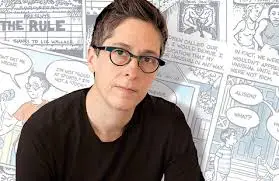
Alison Bechdel in Queer Culture Event in Albuquerque
On May 13, a queer-origin cultural idea returns to what it was always meant to be: women in a room, talking about their lives
That little line may be the most important part of the whole event. There are few cultural inventions stranger than the Bechdel Test.
It is tiny. It is almost comically modest. It asks for so little that you could fit its standards on a cocktail napkin: are there at least two women in a story, do they talk to each other, and do they talk about something besides a man?
That’s it. Three baby steps. Three microscopic expectations. Three grains of rice in the giant buffet line of modern storytelling.
And yet this little “test” has managed to spark decades of argument, defensiveness, parody, debate, misuse, overuse, underuse, and enough comment-section sweating to power a small city.
Which is what makes Alison Bechdel’s May 13, 2026 appearance in Albuquerque feel so deliciously perfect.
Because on that night, at South Broadway Cultural Center, a room full of lesbian+ and queer women, readers, artists, organizers, and community members will gather for “An Evening with Alison Bechdel” — or, depending on which page you read, “A Night with Alison Bechdel.” Even the title is doing a little shape-shifting, which feels fitting. The Bechdel Test has been shape-shifting for decades, too: a joke, a comic bit, a feminist shorthand, a cultural flashlight, a bureaucratic checkbox, a meme, a teaching tool, a tired talking point, a useful starting point, and occasionally a weapon in the wrong hands.

What might be the most important part of the whole event quietly reveals what so much public culture still misses: the real story was never just whether two women spoke to each other in a fictional scene. The real story was that women already were speaking to each other — in lesbian communities, in feminist communities, in friendships, in organizing spaces, in art scenes, in bookstores, in theaters, in lobbies before events — about work, money, politics, heartbreak, survival, joy, art, fear, strategy, aging, longing, housing, books, bad bosses, and where to get decent coffee afterward. The movies were the ones lagging behind. That is why the Bechdel Test lasted.
Not because it is perfect. Not because it is complete. Not because it settles anything. It lasted because it exposed, with almost rude simplicity, how low the bar had been all along. One of the funniest twists in modern culture is that the Bechdel Test — a phrase now spoken with the grave seriousness of a constitutional amendment — was, by Bechdel’s own telling, a joke.
That matters.
Not because the idea is unserious, but because jokes are often where truth first slips through the door wearing sneakers. They arrive faster than theory. They make people laugh before they realize they’ve been accused of something. And then, if the joke is especially sharp, the culture grabs it, runs off with it, builds a cottage industry around it, misquotes it for twenty years, and eventually asks the original artist to explain it forever like an exhausted customer-service rep for civilization.
The rule first appeared in Dykes to Watch Out For, Bechdel’s beloved comic strip chronicling lesbian life, politics, friendships, and community. Importantly, the origin story is more queer, more collaborative, and more charming than the flattened mainstream version usually allows. Bechdel herself has made clear that she did not invent the actual rule alone; the concept is credited to Liz Wallace, Bechdel’s friend, whose name appears in the strip. That detail matters, too. Because in a culture obsessed with branding everything into a single proper noun, it is almost moving to remember that one of the most famous feminist pop-culture ideas of the last forty years emerged from lesbian conversation and friendship, not from a think tank, a TED Talk, or a consulting firm with a logo. It came from community. Of course it did.
And like many queer-origin ideas, it was later sanded down, mainstreamed, detached from its ecosystem, and distributed as a universal culture-war talking point. The lesbian roots often got blurred. The humor got blurred. The credit got blurred. The context got blurred. Suddenly an idea born in a living, breathing queer world was being treated like a neutral little content-rating sticker for the multiplex. That flattening is part of the story.
So is the fact that the test still works anyway.

Why three tiny rules make people so emotional
The answer is not complicated: people get emotional because the test reveals something embarrassing.
Not that every film must revolve around women. Not that every story must be a feminist masterpiece. Not that every male-centered narrative is invalid. It reveals something much smaller, and therefore much harder to explain away: in a huge number of stories, women are not imagined as full subjects with lives of their own.
That’s the sting.
The test does not prove that a movie is feminist. It does not prove that a story is deep, radical, or liberating. A movie can pass and still be shallow, sexist, or ridiculous. A movie can fail and still offer a complicated, powerful female character. That has always been true. Pulp Fiction can pass. Gravity can fail. If that makes you feel like your filing system has burst into flames, congratulations: you are understanding the point.
The Bechdel Test is not a halo. It is a flashlight.
It does not tell you everything. It tells you where to look.
And what it has illuminated, again and again, is the old habit of treating women not as centers of consciousness but as satellites orbiting someone else’s story. Wives, girlfriends, victims, muses, plot devices, emotional support systems, decorative presences. Present, perhaps. Important, perhaps. But not fully alive on their own terms.
Bechdel has framed the deeper issue beautifully: the representation of women as subjects, not objects.
That phrase lands because it reaches beyond the test itself. Subjecthood is bigger than dialogue. Bigger than screen time. Bigger than quotas. Bigger than whether two named women exchange six lines about a horse, a budget, or the collapse of democracy. Subjecthood means interiority. Agency. Complexity. Desire. Contradiction. Decision-making. A life that does not disappear when the male lead exits frame left.
And once you start noticing subjecthood, the whole conversation gets more interesting.
The weird afterlife of a lesbian comic rule
Only in this era could a line from a lesbian comic strip become both a global cultural reference and a weird little administrative tool.
There are databases. There are websites. There are APIs. There are crowd-sourced lists assigning films scores. There are debates about false positives and false negatives. There are institutions tempted to turn the whole thing into compliance theater. Somewhere along the way, the joke became machine-readable, which feels like the most late-capitalist sentence ever typed. Humanity: take a nimble piece of lesbian cultural wit, feed it to an algorithm, then argue about edge cases until morale improves.
And yet even that absurdity tells us something.
If people are trying to automate the Bechdel Test, it is because the underlying problem is so obvious that even our tools can detect part of it. But only part. An algorithm may count named women and lines of dialogue. It cannot measure aliveness. It cannot measure subjecthood. It cannot tell whether a woman is being rendered as a mind, a force, a self. It can count voices. It cannot hear dignity.
That’s where art comes back in.
That’s where community comes back in.
That’s where a live event in Albuquerque starts to matter more than a thousand online rankings.

What happens when the meme enters the room
On paper, the May 13 event is a ticketed cultural appearance at a city venue. The listed prices are clear: VIP for $60, Tier 2 for $40, Tier 3 for $25. The venue is South Broadway Cultural Center. Doors open at 6:00 PM, specifically so people can meet the community before the show starts at 7:00 PM. The city’s event language includes practical details about refunds, exchanges, and official ticketing. These are the ordinary bones of a public arts event.
But the flesh of the night will be something else.
It will be the line forming before the doors.
The friend introducing a friend.
The person who has loved Fun Home for years.
The person who came through Dykes to Watch Out For.
The younger queer attendee who knows the “test” before she knows the strip.
The older lesbian who remembers when lesbian culture had to build its own stages because no one was offering one.
The organizer checking details while also making sure newcomers feel welcome.
In the abstract, the Bechdel Test asks whether women talk to each other about something besides men. In practice, queer women’s community spaces have been doing exactly that forever. They have done it in bookstores, bars, potlucks, living rooms, campuses, newsletters, activist circles, poetry readings, mutual-aid projects, and arts venues. They have done it not as theory but as survival.
Which is why Albuquerque’s version of this story matters.
This is not just a celebrity stop on a speaking calendar. It is not just an author event. It is not just a famous-name night. It is a moment when an idea that came out of lesbian cultural life gets re-embedded in actual lesbian and queer community. It gets lifted out of the flattening internet discourse machine and placed back among bodies, voices, jokes, friendships, organizers, and local energy.
That changes the scale of the story.
It becomes less about scoring films and more about what community feels like when it sees itself reflected.
Not a purity test. A starting point.
One reason the Bechdel Test has endured is that it is so portable. You can explain it in seconds. You can use it at dinner. You can use it walking out of a movie. You can use it badly on social media. You can use it smartly in a classroom. You can hand it to a teenager and watch a whole worldview click into place. It is one of those rare cultural tools that is both simple and catalytic.
But simple tools are always vulnerable to misuse.
The temptation is to turn the test into a moral grade: pass equals good, fail equals bad, case closed, everybody go home. That’s the lazy version. The useful version is more alive than that. The useful version asks: what do these patterns reveal? What assumptions live underneath them? Who gets treated as a full person? Who gets framed as supporting architecture? What does this story imagine women are for?
Those are richer questions.
They lead somewhere.
And maybe that is the real invitation of May 13.
Not just to celebrate Alison Bechdel. Not just to applaud a famous cultural shorthand. Not just to enjoy a smart, funny evening in Albuquerque. But to keep following the conversation past the test itself.
What do we want from stories now?
What do we want from institutions?
What do we want from culture?
What does it mean to portray women — lesbian women, queer women, all women — not as decorative presences but as subjects of history, comedy, grief, argument, labor, intellect, and desire?
Those are much bigger questions than three rules can hold.
But three rules were enough to pry the door open.
Albuquerque event listing (City of Albuquerque): https://www.cabq.gov/artsculture/south-broadway-cultural-center/events/an-evening-with-alison-bechdel
Ticketing page (Arts & Culture): https://artsandculture.cabq.gov/13659/13660
“The Rule” (origin + Liz Wallace credit): https://dykestowatchoutfor.com/the-rule/
“Testy” (Bechdel reflection, virality, Woolf link): https://dykestowatchoutfor.com/testy/
Bechdel Test Movie List (homepage): https://bechdeltest.com/ BechdelTest.com API documentation (license + scoring definitions): https://bechdeltest.com/api/v1/doc FiveThirtyEight
ROI analysis: https://fivethirtyeight.com/features/the-dollar-and-cents-case-against-hollywoods-exclusion-of-women/ NAACL-HLT 2015 paper (automating Bechdel): https://aclanthology.org/N15-1084.pdf U.S.
Copyright Office Fair Use FAQ: https://www.copyright.gov/help/faq/faq-fairuse.html 17 U.S.C. § 107 (Fair Use statute text via Cornell LII): https://www.law.cornell.edu/uscode/text/17/107
Looking for more lesbian and queer events in Albuquerque? Join our community and sign up for the Your Lesbian World Newsletter or ABQ Queer Women’s Meetup and never miss a gathering again.
Want to support queer women doing the work?
📰 Subscribe to Your Lesbian World
🌐 Visit LesbianEarth.com
❤️ Support Lesbian+ and Queer Women businesses
🎉 Support Lesbian and Queer Women Events
❤️ Say yes to something rooted, real, and built by us
We don’t need permission to exist.
We just need each other.
With love and fire,
Your Lesbian World / LesbianEarth